
Intro
This is post three in our series on the well put together homeowner’s toolkit. In the previous two installments, we covered how to make good choices when looking for a hammer and an assortment of screwdrivers. There’s also a directory of all our posts on tools in the Subject Matter Organizer. Links below may be affiliate links; see Disclosure on Affiliations .
Pliers
Usefulness Group: Essential
Pliers have a couple of different functions depending on the type you are looking at. The common parts will be that they’ll have handles and jaws joined by a pin. The jaws will nearly always be shorter than the handles (some extra long needle nose types are an exception). What this arrangement allows for is a lever action where the force you put on the handles is increased, giving the jaws more gripping power. At the core, that’s what pliers are for, to grip something you’re working on stronger than you could with just your hands. That same action can also be used to cut materials if you have a cutting edge instead of a wider jaw. See figure 1 below for a visual on how pliers work.
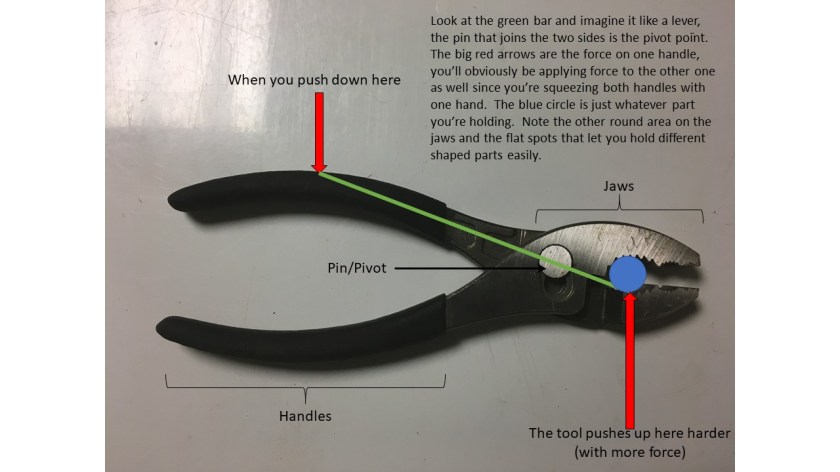
- Slip Joint – Standard pliers like the ones in figure 1 above
- Linemans – Heavy duty and great with heavy wire
- Needle Nose – Gets you into tighter spots and finer wire work
- Wire Cutters – Good for snipping all kinds of materials
- Groove Joint – Bigger jaw opening and lots of clamping force

 Learning to Do Things Well